Renewable Energy
The council’s current approach to renewable energy is set out in Policy CP3. Policy SCR4 sets out the council’s approach to and support for Community Led Projects.
The policy approach was reviewed through the Local Plan Partial Update (LPPU) to set out a positive approach for determining applications and guiding development to the most suitable locations.
The revised Policy CP3 sets out the criteria for all stand-alone renewable energy projects, as well as specific criteria for wind energy and ground mounted solar.
Through the LPPU, the council has set out a landscape-led approach for wind energy and ground-mounted solar PV to guide development to the best locations which is based on the Landscape Sensitivity Assessment (LSA) for Renewable Energy Development (LUC, 2021).
Paragraph 165 of the NPPF states that the planning system should support renewable and low carbon energy and associated infrastructure. To help increase the use and supply of renewable and low carbon energy and heat, plans should:
- provide a positive strategy for energy from these sources, that maximises the potential for suitable development, and their future re-powering and life extension, while ensuring that adverse impacts are addressed appropriately (including cumulative landscape and visual impacts).
- consider identifying suitable areas for renewable and low carbon energy sources, and supporting infrastructure, where this would help secure their development; and
- identify opportunities for development to draw its energy supply from decentralised, renewable or low carbon energy supply systems and for co-locating potential heat customers and suppliers.
- Community-led initiatives for renewable and low carbon energy should also be supported, giving consideration to the role of neighbourhood planning as well as local plans.
Further detailed guidance on developing policies on renewables and low carbon energy and the planning considerations involved in such schemes is provided in the Planning Practice Guidance (PPG). As of July 2025, further guidance is anticipated on assessing community support for wind energy and mechanisms for community benefit, such as reduced energy bills for host communities.
Since the adoption of the LPPU there have been changes to national policy issued by the Government in relation to Wind Energy, through the release of 5th September 2023 Written Material Statement (WMS) and subsequent revision to the NPPF.
Through the WMS the Government is seeking to restart development of onshore wind in England. The NPPF has been revised to allow alternative ways of identifying potential locations for new wind farm developments, rather than solely local development plans. This now includes local and neighbourhood development orders, or community right to build orders.
There have also been changes to the wording around the test applied in relation to community backing of onshore wind, on which further guidance is expected from the Government on how public support for wind farms will be assessed, and how communities that host wind farms could benefit from lower energy bills.
In addition, draft revisions to National Policy Statements EN-1, EN-3 and EN-5 (April 2025) reinforce the strategic importance of renewable energy infrastructure and support the Clean Power 2030 ambition. These revisions emphasise the need for local planning authorities to proactively support renewable energy development, including onshore wind, and to integrate community benefit mechanisms.
It was not possible to review the Core Strategy target for renewable energy generation through the LPPU. Consequently, a misalignment exists between the Core Strategy target and the council’s Climate Emergency goal. Stretch Pathway modelling, outlined in the council’s Climate Emergency Strategy 2019-2030, indicates the magnitude and urgency of our ambition in Bath and North East Somerset to achieve our 2030 goal. According to the Anthesis 2019 report, it is suggested that we need a minimum additional 300MW of renewable energy to contribute to the decarbonisation of electricity, heat, and transport. Rapid and large-scale development of local renewable energy installations is essential, such as equipping 50% of existing homes with roof mounted solar PV by 2030, installing solar PV on commercial roof space equivalent to around 116 football pitches, and incorporating approximately 28 large (2.5 MW) wind turbines.
Through National Policy there is no prescribed way of determining how much energy should be generated from installations located within Bath and North East Somerset. However, in order to explore the implications of our Climate Emergency 2030 target on renewable energy development and to provide an indication of the scale of the challenge, refer to our evidence base, specifically the Renewable Energy Resource Assessment Study (RERAS).
The RERAS was commissioned, working with our partners (South Gloucestershire, North Somerset and the West of England Combined Authority (WECA)) to ensure a consistent approach across those areas. As part of this, we have projected local energy demand in Bath and North East Somerset in 2030 based on the assumption that we are living in a carbon neutral scenario.
The RERAS presents a ‘snapshot’ theoretical projection of local energy demand in 2030 in terms of Gigawatt hours (approximately 1,260 GWh), and it is based on a number of assumptions. The RERAS outlines three scenarios regarding the number and mix of additional solar and wind renewable energy installations in Bath and North East Somerset to meet the projected 2030 local electricity demand.
However, the council's ambition for a minimum 300MW surpasses the first two scenarios in the RERAS, and as the RERAS recommends these are presented as scenarios rather than targets, we have not included these as options within this document.
Given this misalignment, we considered that linking back to the council's Climate Emergency declaration and emphasising the 300MW minimum target is the most appropriate way forward. This approach ensures a clear connection between planning applications for renewable energy and the overarching climate targets, allowing for flexibility over the plan period in case of changes to targets or evolution in the evidence base. Notably, evidence base documents, such as the RERAS, act as snapshots in time and are based on assumptions. This strategic approach helps avoid scenarios like the LPPU policy review, where the target was set in the Core Strategy many years before the declaration of the Climate Emergency by the council.
Comments were received on the renewable energy target options during the previous consultation, and these will be reviewed and taken into account as we move towards the Draft Plan.
In the previous Options Consultation, the council sought views on the proposed approach to renewable energy development, including the strategic target and policy direction. However, the consultation did not include the mapping of safeguarded areas for wind energy, which was intended to support interpretation of the policy options.
To address this, the council is now undertaking a focused re-consultation to provide the missing mapping and enable more informed feedback. This also offers an opportunity to reflect on the comments already received on the renewable energy approach, which will inform the Draft Plan.
Given that Policy CP3 has recently been reviewed, the policy approach could be regarded as appropriate to take forward into this local plan. Recent interest from solar PV operators, including the permitted 15MW solar farm at Marksbury Plain, highlights the growing commercial appetite for renewable energy development in the district.
The Renewable Energy Resource Assessment Study (RERAS) provides a technical assessment of the potential for renewable energy technologies across Bath and North East Somerset. It identifies potential areas for wind energy and solar PV based on a range of criteria, including turbine size, in line with national policy expectations.
The RERAS shows that the potential opportunities for large scale wind are limited within the district. To support delivery, the council is proposing an option to safeguard the most technically viable areas for wind energy (as shown in the map below), helping to ensure they are not compromised by other forms of development.
It is important to note that both the safeguarded areas and the broader areas of search are identified as potentially suitable for wind energy. Their inclusion does not imply that planning permission would be granted. All proposals will be assessed against detailed policy criteria, other relevant local plan policies, and national or neighbourhood planning policy.
Given the sensitivity of some of the identified areas (including National Landscapes), it is not proposed to restrict these locations to large turbines only. A flexible approach to turbine size is preferred, supporting increased renewable energy generation while balancing all considerations.
In contrast, the RERAs shows that the solar resource is widespread across the district. As such, safeguarding specific areas for solar PV is not considered necessary.
Options have also been presented for policy approach that could be applied to build upon the landscape led approach adopted currently in Policy CP3.
The Renewable Energy Resource Assessment Study (RERAS) Map
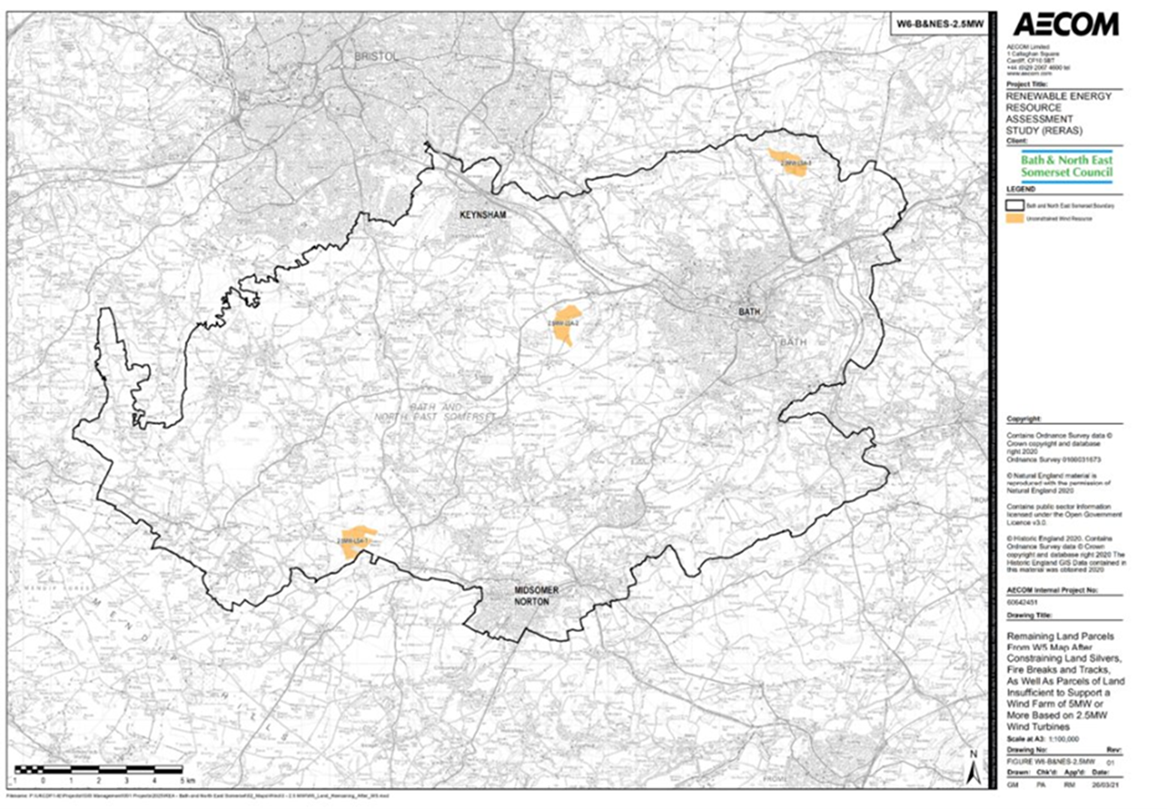
C/RE: Renewable Energy – Proposed Options
| No | Options | Advantages | Disadvantages |
| 1 | Keep the broad areas of search approach established through the LPPU, with scope to review or add new elements (e.g., mine-water storage). | Approach recently adopted and seems to be appropriate, | Broad areas of search may lack the certainty for developers or communities when looking for opportunities. |
| 2 | Safeguarding of our best potential sites for wind energy (protecting them from being compromised by other forms of development) – see map above | Safeguarding the best sites for wind energy ensures optimal utilisation of resources. These sites are selected based on favourable wind conditions, maximizing the efficiency and output of wind turbines. | Safeguarding specific sites for wind energy may limit alternative land uses, such as agriculture or recreation. This can lead to conflicts with other interests. |