Housing Development Boundaries
Housing Development Boundaries (HDBs) are designated areas within towns and villages where residential development is considered appropriate in principle. HDBs are defined to support the delivery of housing, including small windfall sites, within the local plan’s policy framework, subject to other policies e.g. relating to quality of development, site access etc.
The towns and villages with a defined HDB and the respective policy frameworks are identified in the table below. Villages washed over by the Green Belt are subject to Policy GB2 and have a defined infill boundary instead of a HDB. In addition, there are a range of smaller villages and hamlets in the district where a HDB or an Infill Boundary is not defined. These settlements are treated as open countryside with regard to the policy framework for residential development.
Location Policies
The Policy Framework for the location of new development is as follows:
| Location | Policies |
| Bath | Policies B1, B2, B3, B3A, B3C, B4 |
| Keynsham | Policies KE1, KE2, KE3A & B, KE4 |
| Midsomer Norton, Westfield & Radstock | Policies SV1, SV2, SV3 |
| Paulton, Peasedown St. John | Policy SV1 |
| Timsbury, Camerton, Hallatrow, High Littleton, Farrington Gurney | Policy SV1, and Policy RA1 or RA2 |
| Bathampton, Batheaston, Bathford, Bishop Sutton, Clutton/Temple Cloud, Compton Martin, East Harptree, Farrington Gurney, Farmborough, Hinton Blewett, Saltford, Camerton, Ubley, West Harptree and Whitchurch | Policy RA1 or RA2 |
| Whitchurch | Policy RA5 |
As part of work on the Local Plan Options, the council has reviewed the HDBs to update the existing boundaries to account for recent housing development, planning consents, potential allocations, and any identified anomalies.
In addition to this routine review of HDBs, the council is proposing an option to revise the HDB guiding principles which have been developed for consistency in defining boundaries. Currently, the principles state that a HDB should be defined tightly around the housing of a settlement, excluding large residential gardens of properties at the edge of settlements. An option is proposed to amend the HDB guiding principles to define boundaries around the residential curtilage of housing on the edge of settlements, therefore including larger gardens.
The inclusion of larger gardens within HDBs could enable some small-scale opportunities for additional housing to come forward in villages, subject to other policy controls. Minor incremental change in villages is helpful to maintain rural population levels and therefore, services and facilities, as well as making a modest contribution to meeting overall housing requirements.
Parish and town councils have been informally consulted on the proposed boundaries and option to amend the HDB guiding principles prior to formal consultation. Parish and town councils were invited to view the proposed HDB boundaries.
Options as relates to HDB guiding principles are presented below, alongside an example to illustrate how such changes might affect the extent of HDBs.
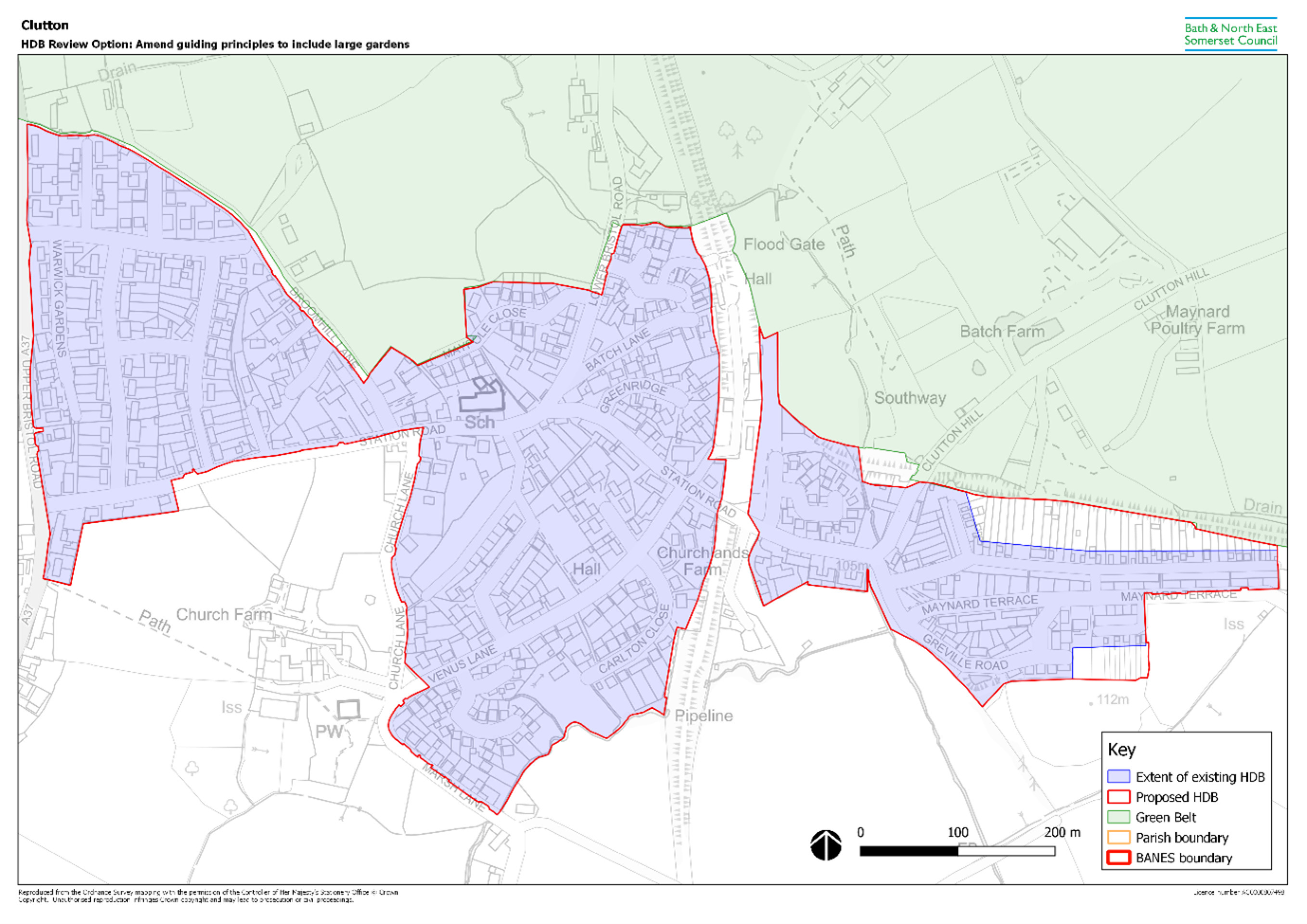
H/HBDs: Housing Development Boundary Review – Proposed Options
| No | Options | Advantages | Disadvantages |
| 1 | Amend the HDB guiding principles to define boundaries around the residential curtilage of housing, therefore including larger gardens. | Enables some small-scale opportunities for additional housing to come forward in villages, helping to maintain rural population levels and therefore, services and facilities, as well as making a modest contribution to meeting overall housing requirements. | Amend the HDB guiding principles to define boundaries around the residential curtilage of housing, therefore including larger gardens. |
| 2 | Retain the existing HDB guiding principles to define boundaries tightly around the housing of a settlement, excluding large residential gardens at the edge of settlements. | None identified | Lack of consistency between existing HDBs |