The Hollies Gardens
Project Area: High Street North
Site location
The Hollies Gardens is a welcoming and much appreciated area of green space at the heart of the High Street. It has its origins as the gardens to the original house, and the historic maps from the Victorian era appear to show a glasshouse on the gable end of the listed building which would have presumably given on to the space.
Today the area has several roles as both the intersection of several pedestrian routes and also as a static space with seating and as a space used for markets and other events.
The space faces south east and benefits from good year-round light and it has a significant change in levels from the High Street leading up towards Sainsbury’s.
Furthermore, whilst it has some elements of active frontage including the library entrance, several elements such as those from the commercial units on the eastern side are quite substantially screened off from the space and so aren’t able to contribute to the animation of the place.
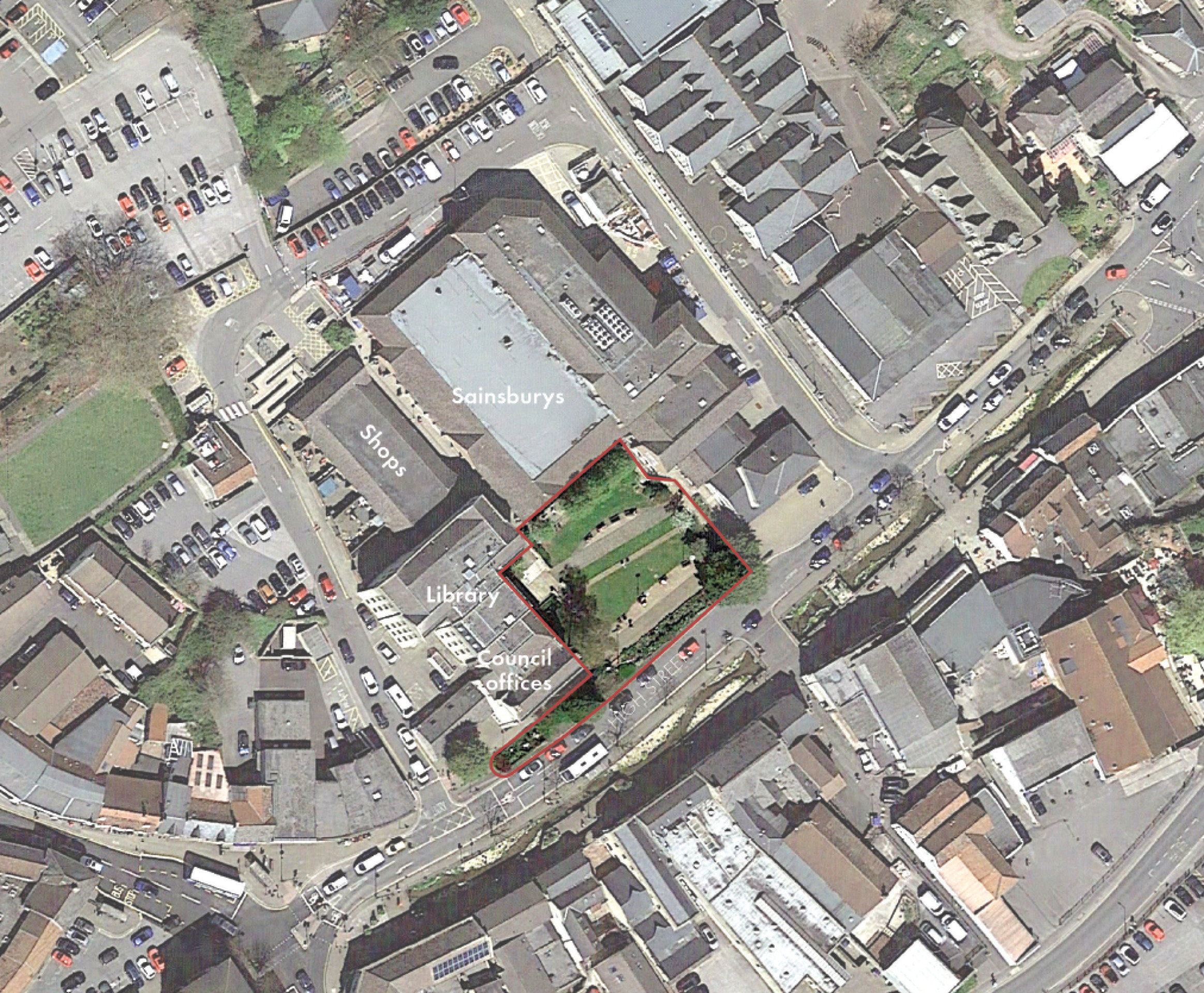
Site location – click to enlarge
Existing condition
As well as being a key connecting route from the High Street to Sainsbury’s and the car park beyond the gardens provide a valuable static space for events including the farmers’ market and plenty of seating both as benches and a low retaining wall.
A key limitation of the space in its role for events is the subdivided nature, with a series of split levels and the intermediate ramp which crosses diagonally across the route.
The inclusion of significant areas of planting makes a strong contribution to the town centre character, whilst two mature yew trees in the south eastern corner have a high value in both heritage and ecological terms.
A further consideration to the east of the space is that the wide pavement is commonly used as a loading area, both for the market, and also informally by other drivers, despite the lack of formal designation.
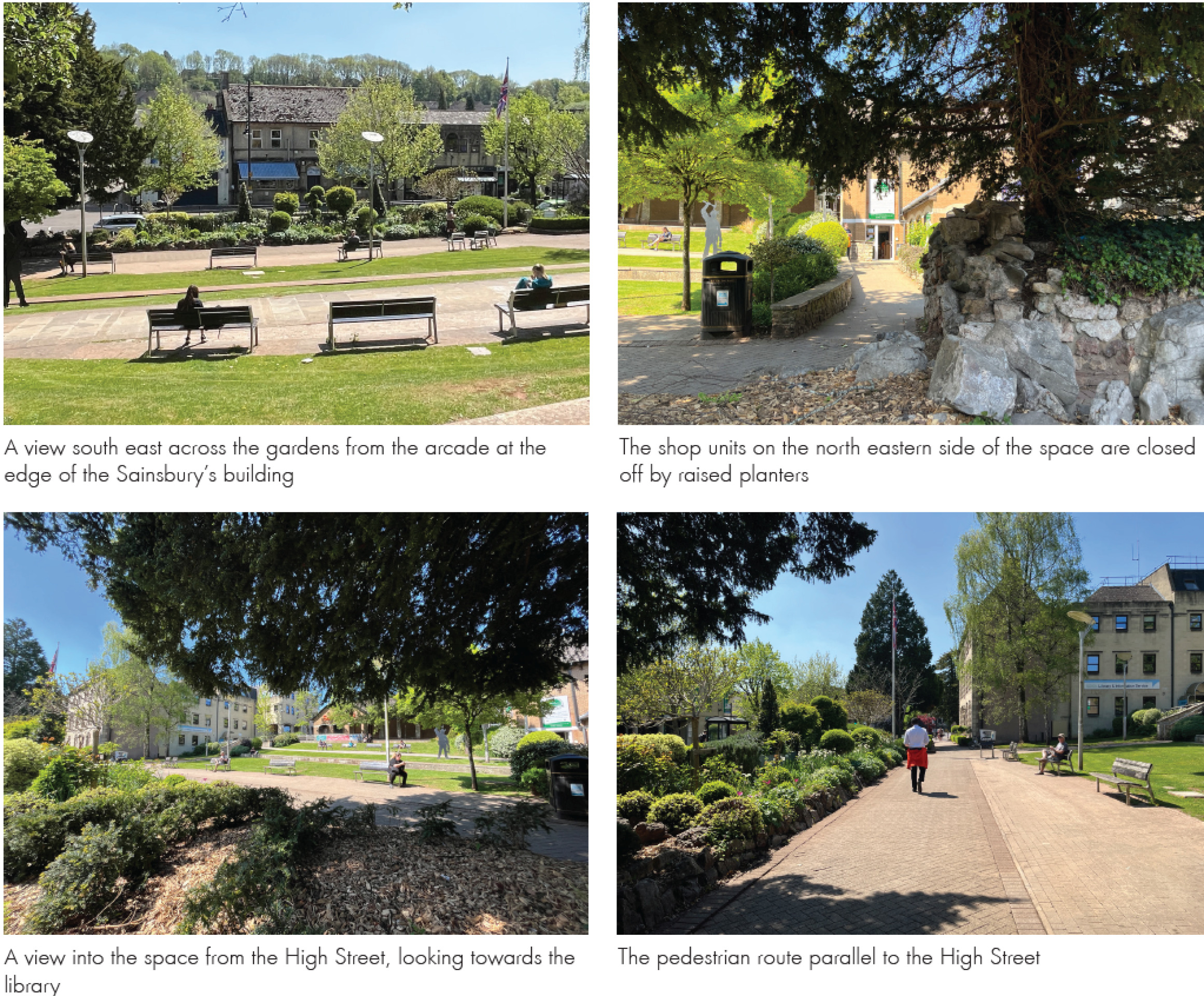
Photographs – click to enlarge
Stairs and ramps
This plan indicates the arrangement of the stairs and ramps in the gardens, including the intermediate level which is the access into the Library.
A significant feature of the ramp arrangement is that anyone accessing the library from the direction of Sainsbury’s and the large area of parking beyond is forced to descend the ramp almost all the way down to High Street level before climbing back up to the intermediate library level. This replaces a direct route of a few paces and eight steps with a distance of over 85m.
Both the ramps and the stairs are very narrow in parts. The middle third is tightly constrained by stone walls and not really wide enough to allow buggies, chairs, or people walking with a companion for assistance to pass easily. The top section of the ramp is beneath a part solid/part pergola structure along the edge of the Sainsbury’s building. It is also worth observing that neither the stepped route or the ramped route actually connect well into the High Street.
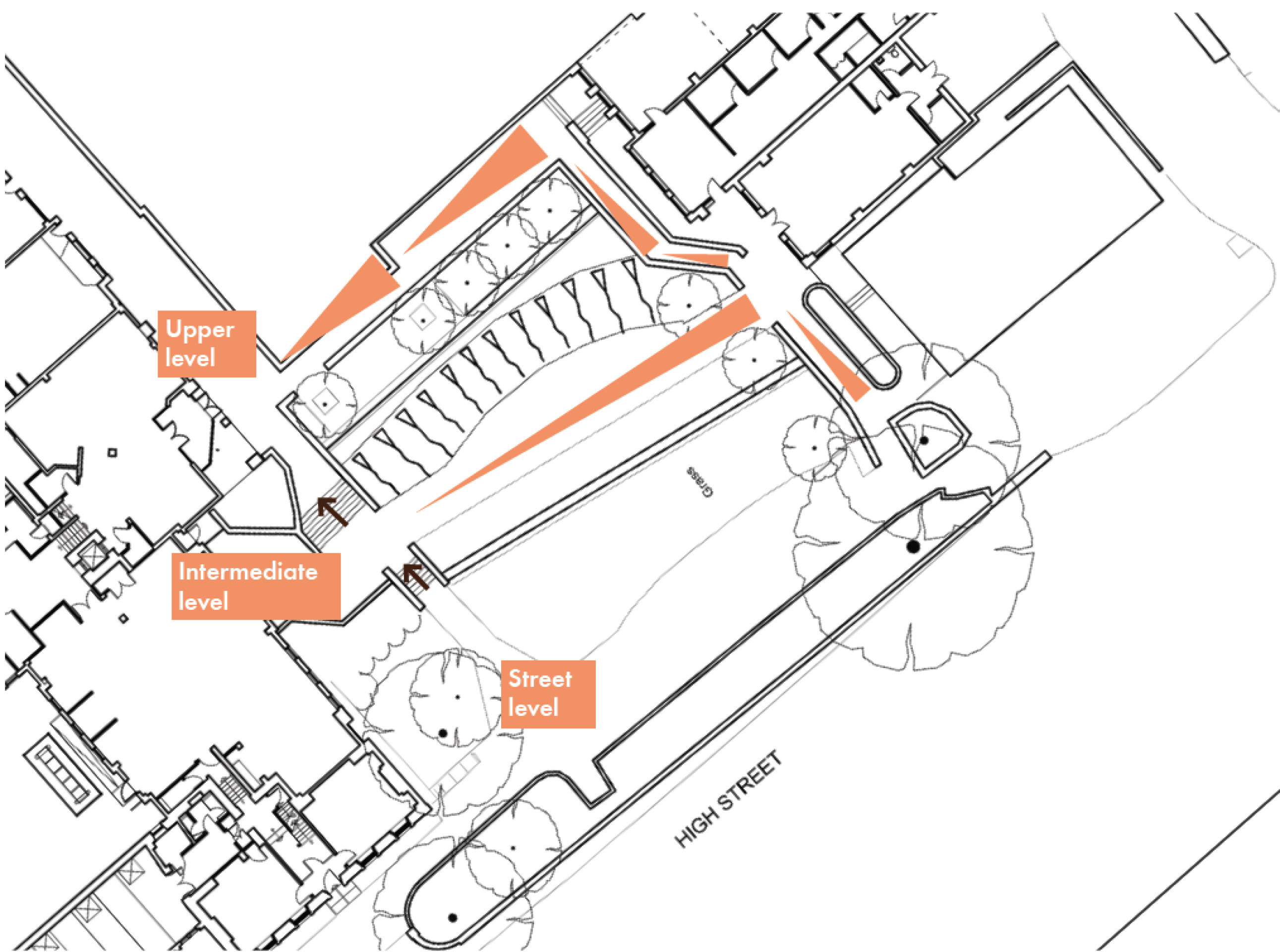
Stairs and ramps plan – click to enlarge
Historic context
The historic house was shielded from the street and privacy given to the garden by a high stone wall. Whilst the original wall has now gone, a memory of it remains in the short stretch of taller wall around the gateway and in the low stretches of wall that enclose the gardens from the street. Fragments of historic tufa wall remain in the south east corner of the space and are noted as a listed structure.
The retained walls create a notable pedestrian pinch point. However, this can be at least partially addressed by addressing the dense ivy and some potential crown lifting of the yew to support its long term health. This would substantially improve sight lines into the space without impacting on the listed structure.
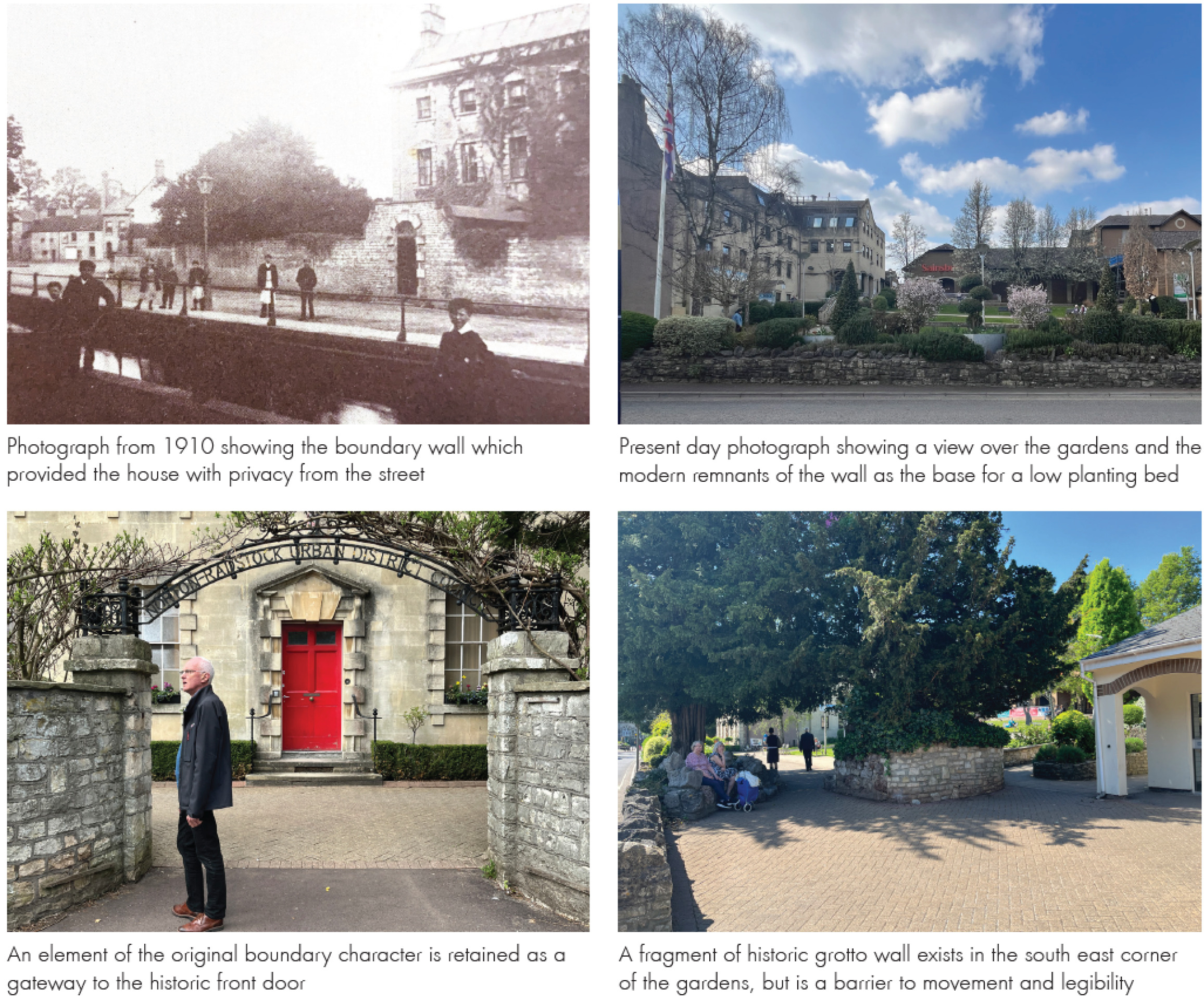
Historic photographs – click to enlarge
Improving access
The original house is a Grade II* listed building, and a key landmark in the town centre. It was sold to North Radstock Urban District Council in 1937 and has been used as council offices in various capacities ever since. With the large expansion of the building to the rear, including the library, in the 1980s the historic frontage has gradually faded in public significance. This is at least in part due to the steps up to the front door which mean that the building doesn’t meet modern accessibility standards for a public venue.
Sensitive adaptation of the street in front of the old house to introduce a ramped access could be delivered as part of the wider public realm impovements. This should be carefully developed to reflect the symmetry of the building, but would open up the potential for much greater activation of the ground floor frontage to public uses including the Registry Office in particular.
Opportunities
A clear and legible route through the space featuring a wider pair of staircases and a simple ramp arrangement which also opens up the existing shop frontages to the space.
A larger level space framed by integrated terrace seating for events including the market.
Play-on-the-way elements encouraging children to be more active and engage with their surroundings.
A new controlled pedestrian crossing on the High Street contributing to safe routes to the primary school, the library and Sainsbury’s.
An acccessible entrance to the front of the Hollies in place of the existing steps, opening up potential for more public-facing uses.
Opportunities for planting which supports biodiversity.
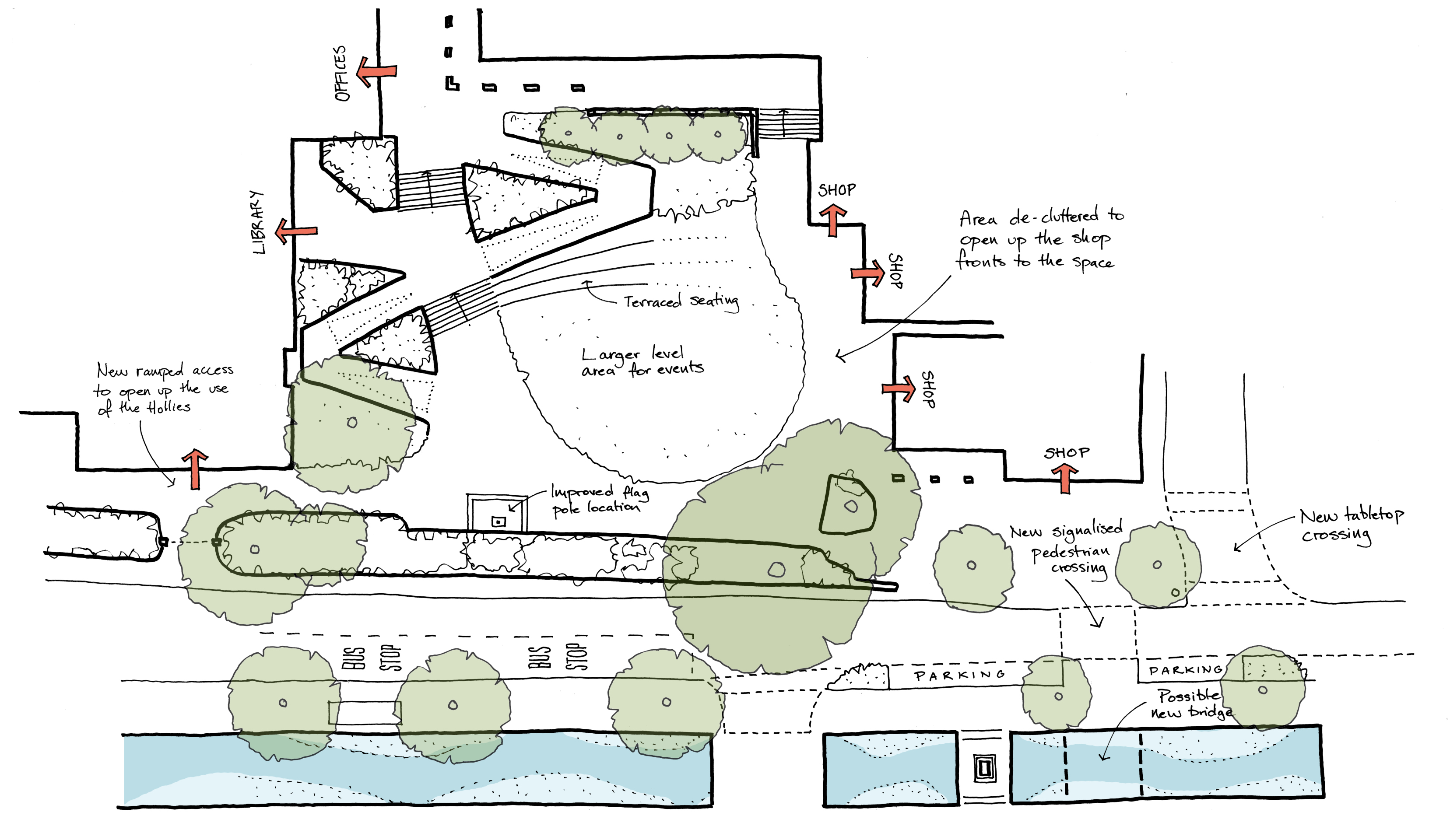
Concept drawing – click to enlarge